Claude Just Remade Pokémon Red in Pure Code—No Image Files, Plays in Your Browser
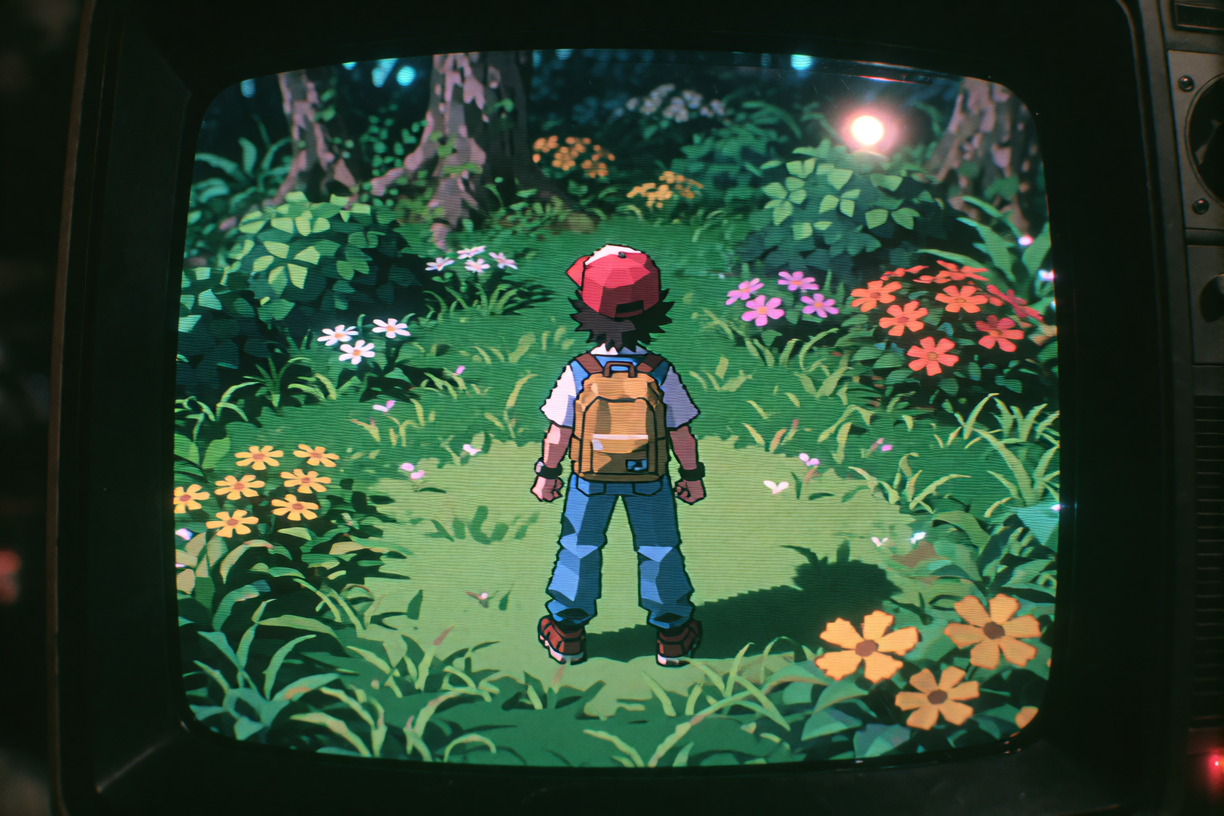
It's September 2026, and someone just remade an entire 30-year-old game inside Claude Opus 5.5 Code, from the first sprite to the final battle animation—and it runs in your browser right now.
Over four days starting September 24, developer Levy Street directed Claude Opus 5.5 to rebuild Pokémon Red pixel by pixel. The result: Pokémon Claude Red, a fully playable remake where every single visual element—all 151 Pokémon, every tile, every battle effect, every song—is pure code. Not a single image file in the game.
That's the thing that's making creators lose it on Reddit and everywhere else. This isn't a model spitting out a PNG. This is an AI that understood the entire 1996 game, translated it into mathematical code that draws itself at runtime, and held all of it together coherently across multiple iterations.
What's Actually in There
The full game includes the entire Kanto story, redrawn pixel art, a social hub, a Battle Tower with competitive matches, and link battles where you can trade and duel with other players. On phones, the layout rotates between Game Boy style (vertical) and GBA style (horizontal). The whole thing responds to keyboard, mouse, touch, and gamepad input.
Each Pokémon is mathematically defined—not as a pre-drawn asset but as a list of ellipses, polygons, and curves that the game rasterizes, shades, and outlines in real time. When you play, your browser is actually rendering thousands of tiny line segments to make Pikachu look like Pikachu.
The music's note data was converted from the original pret/pokered archive, and the songs play from code. All the trainer data, encounters, dialogue, and game logic came from the same public archive, then Opus 5.5 translated it into runnable JavaScript.
Why People Are Obsessed
This hits differently than "AI made an image." You can play it right now, see it move, battle in it, catch Pokémon. It's not a novelty proof-of-concept—it's a functional game with state, persistence, multiplayer. Creators are watching an AI understand game architecture (maps, collision, encounters, turn-based combat), hold an entire codebase in context, and iterate on its own work when parts didn't compile.
On r/ClaudeAI, the top comment thread is full of people comparing it to the bridge engineering benchmark (Opus 5.5's design won a physical load test, holding 130 lbs with minimal material). Both show the same thing: the model can take a huge, coherent problem, break it into parts, execute across days of iteration, and land something that actually works.
What's wild is that this is a side effect of how good Opus 5.5 got at code generation. Levy Street's original prompt was simple: remake Pokémon Red with better graphics and pixel art from raw pixels. Then he just kept playing it and asking for fixes. The model kept context, understood the architecture it had built, and patched things without breaking the whole game.
What's Good About It, What Isn't
The game is stable and playable. Sprites render cleanly. Battles work. The UI is tight. You can actually play through it and feel how well Opus 5.5 grasps visual code generation—shader-like math that produces beautiful output from compact algorithms.
But here's where it gets honest: this is a Game Boy game from 1996. The scope, while dense, is finite. Pokémon Red is a well-documented game with publicly available source code, which gave Opus 5.5 a structured target. The model didn't invent the game; it translated and rebuilt it. That's different from generating a novel game from nothing.
Also: this took a skilled human (Levy Street) iterating constantly for four days, with clear direction and willingness to ask for specific fixes. It wasn't one-shot. Opus 5.5 is doing the hard work, but it's still a conversation, not automation.
How to Try It
Go to claudered.dev and play. It runs entirely in the browser. You can use keyboard (WASD or arrow keys), mouse, touch, or a gamepad. Walk around Kanto, catch Pokémon, battle trainers. The game has all the classic bugs and glitches from the original, recreated deliberately (like MissingNo).
If you want to build something similar: the code is open on GitHub. You'll see how Opus 5.5 structured the whole thing—map data, sprite definitions, battle logic, all in JavaScript.
The real takeaway isn't that AI beat game developers. It's that if you can describe a game, show the model existing code, and iterate with it, you can rebuild complex systems in days instead of months. That's a different workflow entirely.