Gemma 5: What Neon and Hydrogen Tell Us About Google's Next Open Model

This is speculation. Google hasn't announced Gemma 5, and we have no inside information. What we do have is a pattern, two brand-new Gemini models, and some honest feedback from people who run Gemma every day. Sources are at the bottom.
Every Gemma so far has been a small, open echo of a Gemini. Google's own docs describe Gemma as built from the same research and technology as Gemini, and when Gemma 4 launched in April, Engadget's headline said it plainly: a family of open models built off of Gemini 3.
So if you want to guess what Gemma 5 will be good at, the best place to look isn't a rumor on X. It's the Gemini 4 models Google shipped over the last few weeks. And the two newest, Neon and Hydrogen, have a very clear theme.
They're built to do things, not just say things.
What Google just shipped
The Gemini 4 family landed in four pieces this autumn, each one named after an element:
- Argon (October 13) · efficient reasoning, the first one out
- Carbon (November 10) · the heavyweight, for the hardest long jobs
- Hydrogen (November 12) · the fast, cheap everyday model, and the only one with a free API tier
- Neon (November 18) · in between, adapted from Carbon, aimed at complex coding and real work
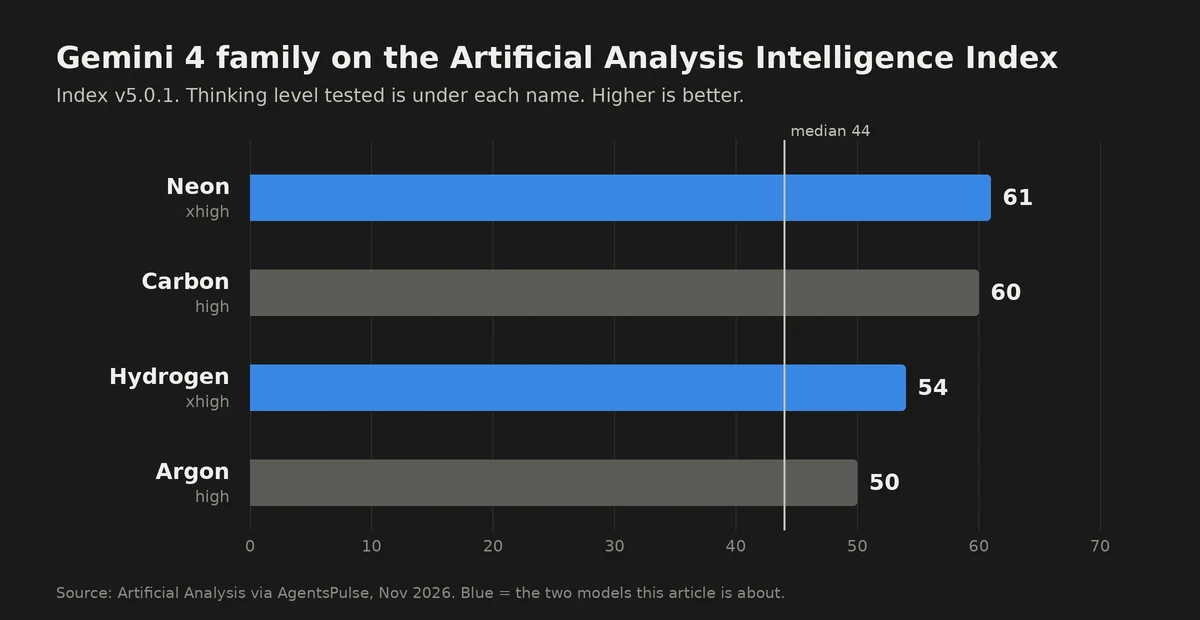
On the independent Artificial Analysis index, Neon actually edges out its big brother Carbon (61 to 60) and finishes faster with fewer tokens. Hydrogen, at half Neon's price, still lands well above the median for models in its class.
But the scores aren't the interesting part. The interesting part is what Google chose to brag about.
The theme: agents that don't fall apart
Read Google's Neon launch materials and almost every headline number is about getting work done over many steps:
- #1 on AutomationBench (56.3%, well ahead of the next-best model's 42.5%)
- #1 on Vending-Bench 2, a test where the model runs a small business on its own for a long simulated stretch
- #2 on the Agent Arena index, and #2 for steerability, meaning how well it does what you actually asked
- Top marks on legal and tax research benches, which are long, tool-heavy, look-it-up-and-check tasks
And the improvements Google calls out aren't "smarter" so much as "steadier": fewer redundant file reads in long sessions, more reliable handling when the conversation has to be compressed, and less making things up.
There's an independent hint that this is real. DataCamp ran the same build task three times on Neon and on Carbon. Neon finished all three. Carbon finished one, and failed the other two by running out of room mid-answer. Three runs isn't science, but it's the kind of boring reliability that agents live or die on.
Then there's the pairing. Google's own examples show Neon planning and checking the work while Hydrogen does the hands-on steps as a helper. The big model thinks, the small fast one acts.
Hold on to that idea. It matters for Gemma.

Where Gemma 4 is today
Gemma 4 is genuinely good. It comes in four sizes, from tiny "effective" 2B and 4B models that run on a phone (and understand audio) up to a 26B mixture-of-experts and a 31B dense model. It's fully open under Apache 2.0. At launch the 31B reached third place on the Arena text leaderboard, with the 26B in sixth. For an open model you can run at home, that's remarkable.
Arena is mostly people chatting with models and voting on which answer they like better. Ranking that high means Gemma 4 talks well. It writes well, explains well and handles creative work nicely. That's what Gemma has always been loved for.

The weak spot shows up when you ask it to act. People running Gemma 4 inside agent setups report a tendency to drift from strict instructions. When a task needs exact JSON every time, or a chain of tool calls that each depend on the last, it's more erratic than models built for code. Nobody has published hard numbers on this, so treat it as community experience rather than a benchmark. But it's a consistent story, and it's the exact thing Neon was built to fix.
Our predictions for Gemma 5
Put those two pictures side by side and the guess almost writes itself. Here's what we expect, from most to least confident.
1. Tool use is the headline. If Gemma 5 is distilled from Gemini 4 the way Gemma 4 came from Gemini 3, it should inherit Neon and Hydrogen's steadiness: cleaner function calls, JSON that matches the schema, and less wandering over long tasks. We'd bet on Google publishing agent benchmarks for Gemma this time, not just chat and knowledge scores.
2. Writing stays strong, but it isn't the focus. Gemma is already very good at writing and creative work. Google doesn't need to spend its effort there. Expect "as good as before" rather than a leap.
3. A pocket-sized Hydrogen. Hydrogen is the cheap, fast model that does the hands-on steps for a bigger planner. The small Gemma models (the E2B and E4B on phones) are the natural open version of that job: a local helper that reliably presses the right buttons, with a bigger model, cloud or local, doing the planning.
4. A smarter mixture-of-experts. When Google DeepMind's Omar Sanseviero asked developers in late October what they wanted in future Gemma models, one recurring request was a mixture-of-experts that beats the dense 31B. Others asked for longer audio, speech output, better handwriting reading and real multilingual nuance. Google asked publicly, so we'd expect at least some of that list to show up.
5. Still Apache 2.0. Gemma 4's switch to a fully open license was a big deal for builders. Going back would be a strange move. Not confirmed, but likely.
6. Timing: sooner than the old cycle suggests. Gemini 3 launched in November 2025, and Gemma 4 followed about four and a half months later. Gemini 4 arrived this October and November. Run the same gap and you land around March or April 2027. Combine that with Google openly asking for wishlists in October, and spring feels right. That's arithmetic, not reporting.

Why this matters
A local model that writes beautifully is nice. A local model that can reliably use tools is a different thing. It can sort your files, fill in forms, drive an app, check its own work and run without an internet connection or a per-token bill.
That's the part of AI that has mostly lived behind paid APIs. Neon and Hydrogen show Google has figured out how to make agents steadier. If Gemma 5 brings even a slice of that to models you can download, it'll be the most useful open release of the year.
At Mirrorize we run a lot of our image models on our own hardware, so we watch open releases closely. We'll write a proper hands-on the day Gemma 5 actually ships.
What to watch for
- A post on the Google Developers blog or the Gemma releases page (that's where Gemma 4 appeared first)
- Agent or tool-calling benchmarks in the Gemma model card, which would confirm the theory above
- Whether the small E-models gain anything Hydrogen-like, such as stronger function calling on a phone
Sources
- 9to5Google: Gemini 4 Neon announcement (launch details and Google's claims)
- DataCamp: Gemini 4 Neon features and benchmarks (benchmark table, pricing, three-run build test)
- AgentsPulse: Gemini 4 models compared (release dates, Artificial Analysis scores)
- Wikipedia: Gemma (language model)) (Gemma history, sizes, license, Arena ranking)
- Wikipedia: Gemini (language model)) (Gemini 4 timeline)
- IAMag: Google asks developers what they want in the next Gemma (the October developer poll)
- IAMag: Gemma 5, what to expect (community feedback on Gemma 4 in agent setups)
Benchmark figures are as reported by the sources above, most of them from Google's own launch materials. Images in this article were made on Mirrorize.