A single vintage screen-printed art print fills the frame edge to edge, rendered on worn warm-cream…
Prompt
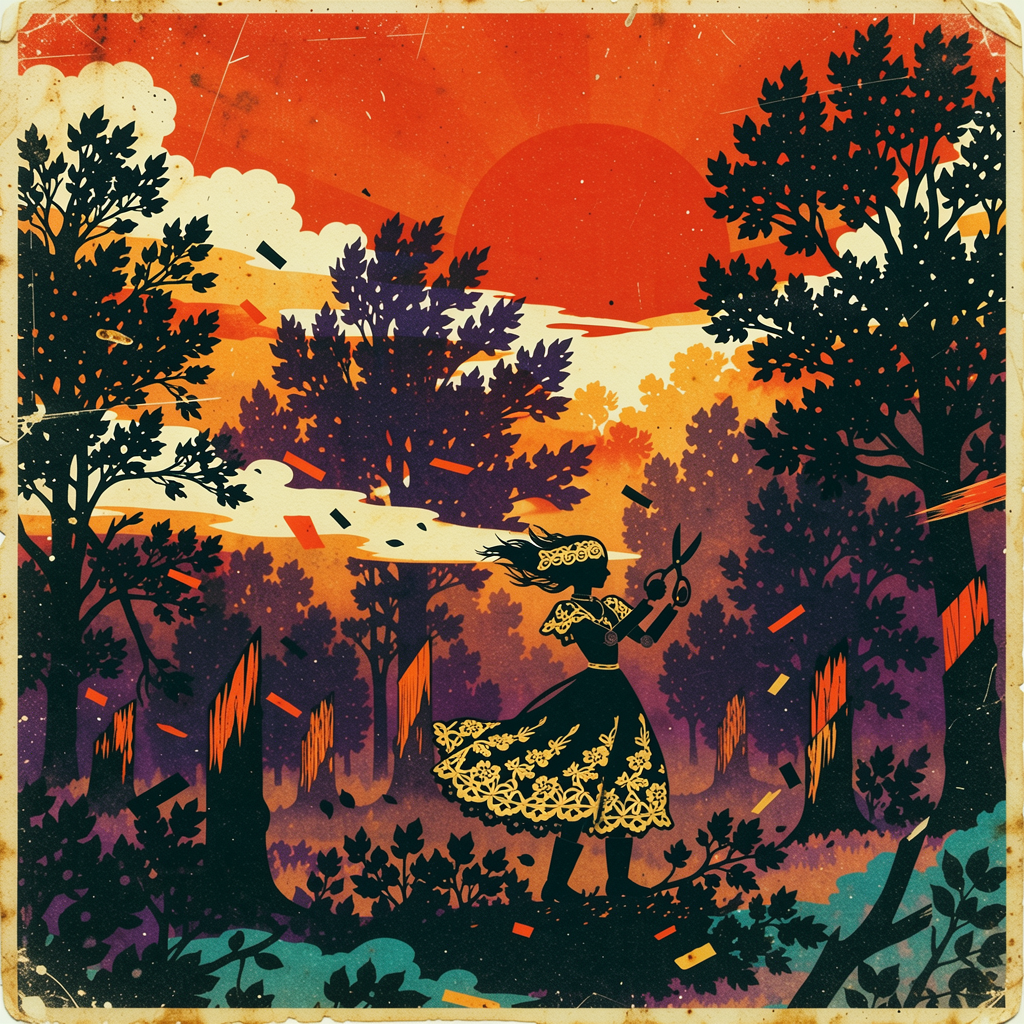
A single vintage screen-printed art print fills the frame edge to edge, rendered on worn warm-cream paper with heavy speckled grain, ink scuffs, foxing, scratches, and distressed edges. The composition is a tall 2:3 portrait scene in an East-Asian-ink-meets-indie-comic manner, dominated by layered silhouettes, rough brush-like outlines, flat misregistered color fills, and a weathered risograph or silkscreen texture. Across the upper half, a large hot vermilion-red sunburst radiates from behind the central forest canopy, its hard rays spreading outward through smoky orange clouds and dark purple-gray atmospheric foliage. The sky and background are divided into receding horizontal and diagonal planes of translucent tissue-like foliage, with upper areas glowing in cream and tangerine and lower areas shifting into deep plum-violet, near-black, and dusty teal-gray shadows. The sunburst is not smooth; it is broken by grime, scratches, uneven ink deposits, and rough printed imperfections, giving the light a rough, tactile surface rather than a digital gradient. In the upper-left and middle-left regions, smoky cream cloud forms and darker tangerine cloud bands stretch diagonally, partially obscured by black ink hatching and dry-brush scratches. Thin diagonal streaks and scattered rectangular shards, mostly red-orange, black, and muted tan, cut across the scene like wind-torn confetti. These shards vary in size from tiny slivers to larger jagged strips, with crisp cut edges and misregistered edges that bleed into the printed texture. The gust of wind is depicted as a horizontal band of these scissor-cut dashes and fragments sweeping horizontally through the tattered scroll-clouds. The overall movement feels lateral and forceful, as if the wind has been sliced into abrupt fragments. The forest occupies most of the frame as a series of layered translucent planes. Large tree silhouettes rise from the lower left, center, and right, their trunks and branches rendered as matte black card-like forms with delicate lacework cutouts in mustard-gold accents. Many trees appear lopped at roughly half height, with ragged tops and clean diagonal scissor notches cut through the trunks and branches. The foliage has a paper-cut quality: black branches with perforated leaf clusters, dotted cutouts, torn edges, and thin inked outlines. Behind them, pale tangerine and cream foliage layers glow under the red sunburst, while deeper foreground layers become dark plum, near-black, and dusty teal-gray, creating strong depth without realistic modeling. Near the center-right foreground stands the only human-like figure, a small wind-pruner puppet shown full body, upright on the lowest foreground plane. The figure is a matte black paper-cut silhouette with a slim build, hinged-looking limbs, and crisp scissor-cut edges that align visually with the rough print grain. The body wears a long, pierced-lace skirt with intricate cutout floral and vine-like patterns highlighted in mustard-gold, a fitted top or bodice, and flat boots. The figure’s head is partly hidden by wind-tossed dark hair or a wrapped head covering decorated with delicate cut lace details. The face is mostly in shadow, with minimal visible features and a calm, resolute, forward-looking posture. One arm extends outward holding a large pair of open scissors or pruning shears, their blades raised diagonally upward to the right. The opposite arm is lifted in a balanced, dance-like pose. The pose suggests the figure has just cut or pruned the forest, matching the diagonal scissor marks and stumps surrounding it. The lower half of the image is dense with pruned tree stumps arranged in receding rows. Many trunks have angular diagonal cuts through their midsections, some marked with red diagonal slash highlights that resemble freshly cut wood. The cut surfaces show warm orange-red patches against black inked contours, making the scissor notches visually prominent. Leaves and small dark branches lie scattered near the base of the central figure, especially toward the bottom-left and bottom-center. Loose petals, torn leaves, rectangular confetti pieces, and thin brush streaks drift across the foreground, reinforcing the sense of gusting wind and recent cutting. The bottom-right foreground includes more dark foliage silhouettes, angular broken branch forms, and muted teal-gray shadows that frame the scene. The entire image uses a limited but varied palette: saturated vermilion red, glowing tangerine and cream, deep plum-violet, near-black, dusty teal-gray, and mustard-gold accents. The lighting is dramatic and flatly graphic, with a mid-dark key contrasted by the blazing red sunburst behind the trees. The image has no clean digital smoothness; its surfaces are grainy, misregistered, scuffed, and hand-printed, combining rough black ink hatching, distressed silkscreen texture, paper-cut silhouettes, and layered tissue-like foliage planes. The mood is wild, defiant, mythic, and fairytale-like, centered on the solitary wind-pruner figure cutting through a transformed forest while the wind appears to sweep through the scene as a band of broken scissor-cut marks.