Night Path
Night Path
Prompt
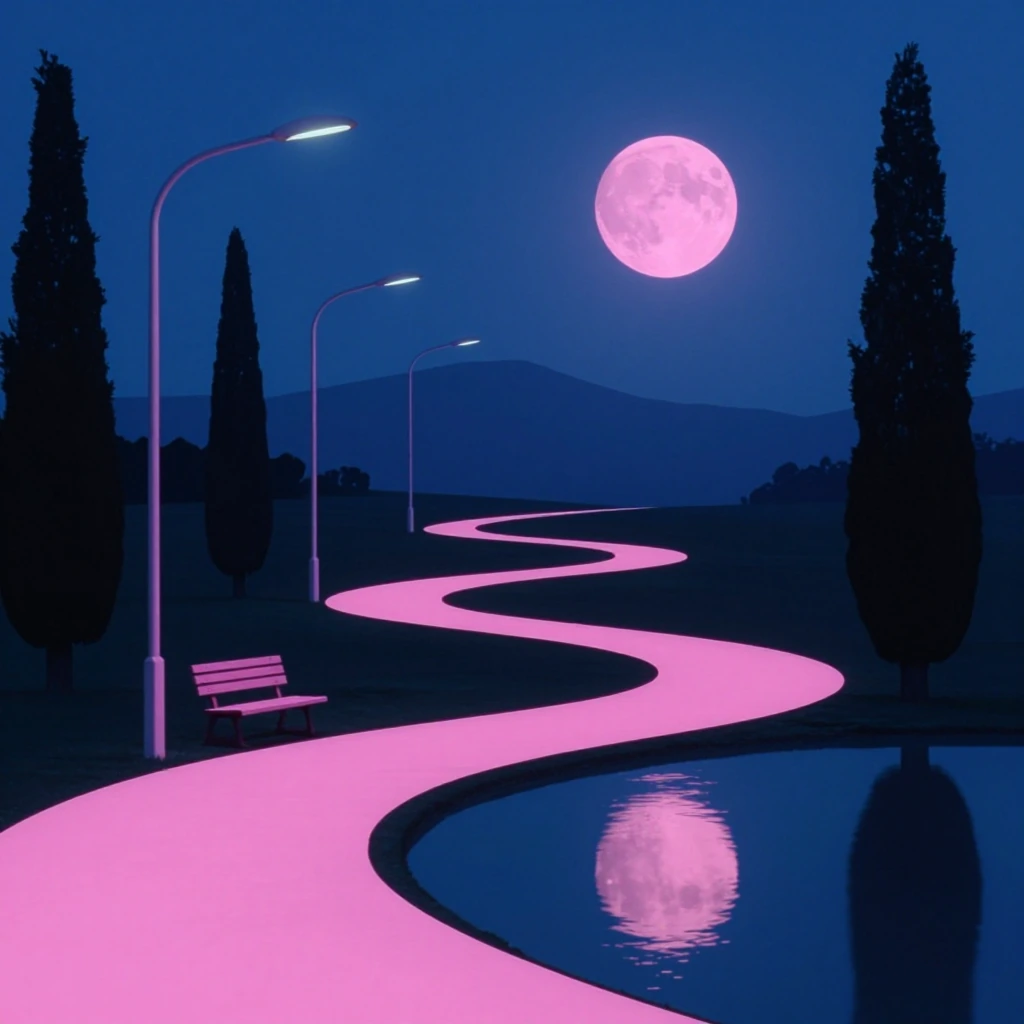
This image is an unsettlingly beautiful masterpiece of contemporary surrealism that feels like a quiet glitch in reality. It is a world where the laws of nature have been rewritten by a digital hand/ yet it feels more like a memory than a machine-made image. ð¨ THE PIECE "Night Path" (or "Pink Moon Park")/ artist unknown (highly likely AI-generated or digital manipulation)/ c. 2023â2024/ Digital Media. ð¤ THE ARTIST While this specific work is part of the anonymous "Dreamcore" wave currently sweeping platforms like Pinterest and Instagram/ it clearly draws inspiration from digital surrealists like Hiroshi Nagai and Toru Kase. These creators are obsessed with the "aesthetic of the empty"âlandscapes that feel lived-in but are currently abandoned/ sitting at the intersection of Japanese pop art and modern liminal spaces. ðï¸ HISTORICAL CONTEXT The work is a primary example of "Vaporwave" and "Dreamcore" aesthetics/ which rose to prominence in the early 2020s. It rejects the grit of traditional realism in favor of a hyper-saturated/ "clean" world that mimics the nostalgia of 1980s city-pop album covers and early computer graphics/ where the artificial is celebrated as a new kind of "natural." ð¼ï¸ COMPOSITION & STRUCTURE The composition is built on a series of elegant/ sweeping curves. The winding pink path serves as the "spine" of the image/ leading the eye from the foreground/ past the park bench/ and toward the distant/ hazy mountains. This serpentine motion is contrasted by the sharp/ vertical lines of the two streetlights and the towering/ dark cypress-like trees. The result is a perfect balance between organic flow and rigid/ man-made structure/ creating a sense of "enforced tranquility." ð¨ COLOR & LIGHT This is a masterclass in Dichromatic Contrast. The Indigo Sky: Occupying the top half of the frame/ the deep blue represents the vast/ silent void of night. Itâs a "heavy" color that pushes down on the landscape. The Pink Glow: The path and the low-hanging moon share the same unnatural/ neon-bubblegum pink. By having the ground reflect the sky's only celestial body so perfectly/ the artist suggests a world that is "lit from within" or purely digital. The Streetlights: Curiously/ the streetlights aren't casting traditional white light; they seem almost redundant in the face of the moon's overwhelming pink radiance/ adding to the dream-like logic where traditional physics don't apply. 𧩠OBJECTS & SYMBOLS The Pink Moon: Positioned almost perfectly in the center-right/ it acts as a "Third Eye" for the landscape. In mythology/ a red or pink moon often signals change or an omen; here/ it feels more like a soft/ digital sentinel. The Park Bench: A classic symbol of Liminalityâa place designed for people that is currently empty. It invites the viewer to step into the image and sit/ turning the viewer into the "missing" protagonist of this dream. The Streetlights: With their long/ curved necks/ they look almost biological/ like metallic herons watching over the path. They symbolize the human attempt to illuminate the dark/ which feels small and quaint against the surreal pink celestial light. The Water/Reflections: The foreground features a dark/ glassy surface that mirrors the blue and pink. This indicates a "double world"âa reminder that in dreams and digital art/ what is "real" and what is "reflected" are often the same thing. ð REFERENCES & DIALOGUES The piece is in a silent conversation with René Magritteâs The Empire of Light/ where the sky is daytime but the ground is in nighttime shadow. It also echoes the lonely/ silent streetscapes of Edward Hopper/ but swaps his 20th-century urban isolation for a 21st-century "online" solitude. There is also a nod to the "City Pop" aesthetic of 1980s Japan/ which often used these exact shades of pink and blue to evoke a sense of high-tech tropical luxury.