Night, an exposed basalt clifftop above open ocean, the figure at the exact edge back to camera, dea…
Prompt
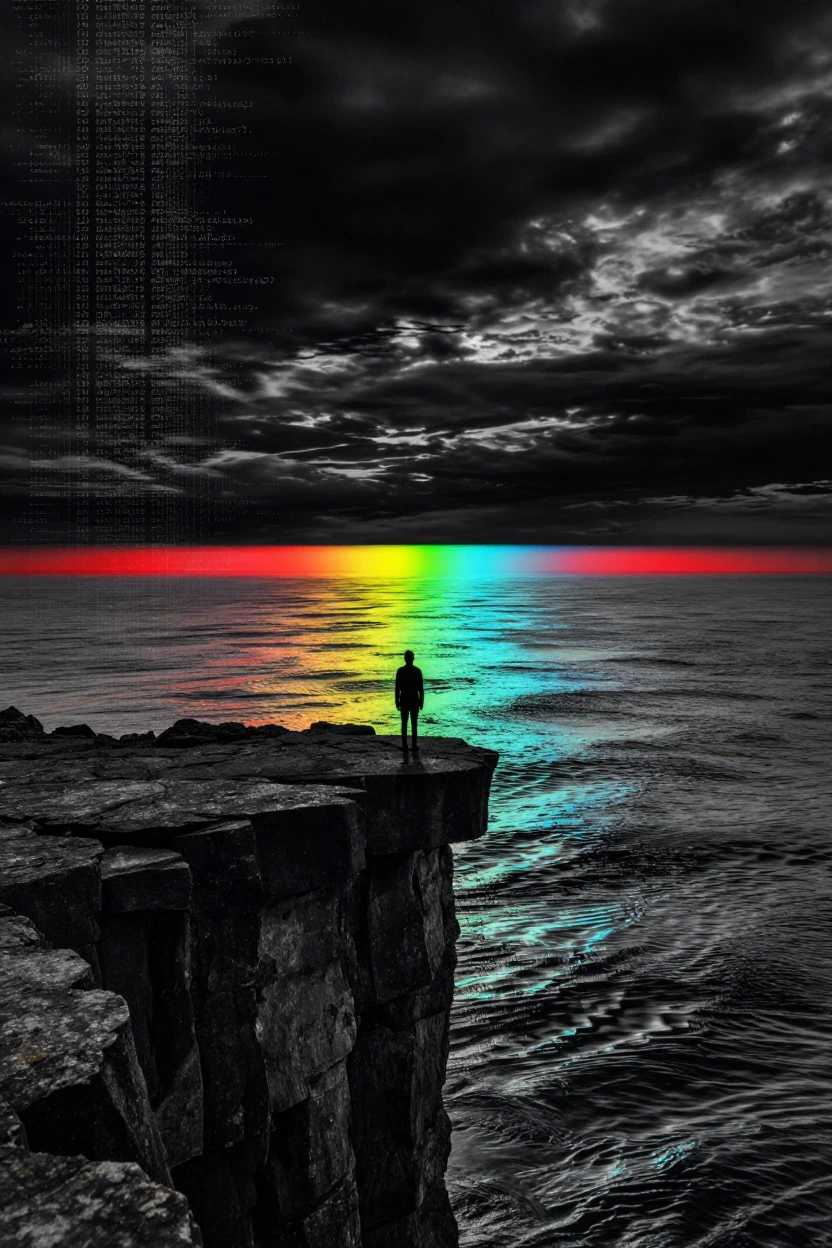
Night, an exposed basalt clifftop above open ocean, the figure at the exact edge back to camera, dead center, shot level so the horizon bisects their waist. The image entirely near-monochrome — cliff, ocean, sky, figure all in charcoal and absolute black, all natural color stripped so the glitch is the image's sole light source. The horizon line is the absolute epicenter of the corruption event — the RGB channel separation is at maximum intensity precisely there: red channel displaced far along the horizontal axis in one direction, cyan-green shearing in the opposite, the channels at their widest separation point, creating the broadest rainbow rupture in the frame — electric cyan, acid green, sharp yellow, hot saturated red — three versions of the same horizon floating in visible misalignment, the sea and sky each existing as three offset ghost-states that will never align again. Below the horizon, the ocean surface is consumed by horizontal datamosh wave distortion flowing downward from the split: sinusoidal pixel waves of slow long amplitude and fast tight surface frequency make the water a flowing field of displaced luminance data, waves within waves, the ocean standing still in pixel displacement. Above the horizon, the sky holds the same distortion at lower amplitude — slower undulations, barely perceptible, the night sky gently liquefied. The left edge of the frame bleeds corrupted text from the top to the bottom of the image — a repeating fragment descending from near-legible to pure horizontal noise, the cliff's left margin serving as a full-height damage display. Horizontal banding stratifies the image — some bands almost clean, others absolute black, some luma-inverted. The figure is split at the horizon: a thin chromatic halo traces their full silhouette, the rainbow residue of existing at the exact point where the image breaks.